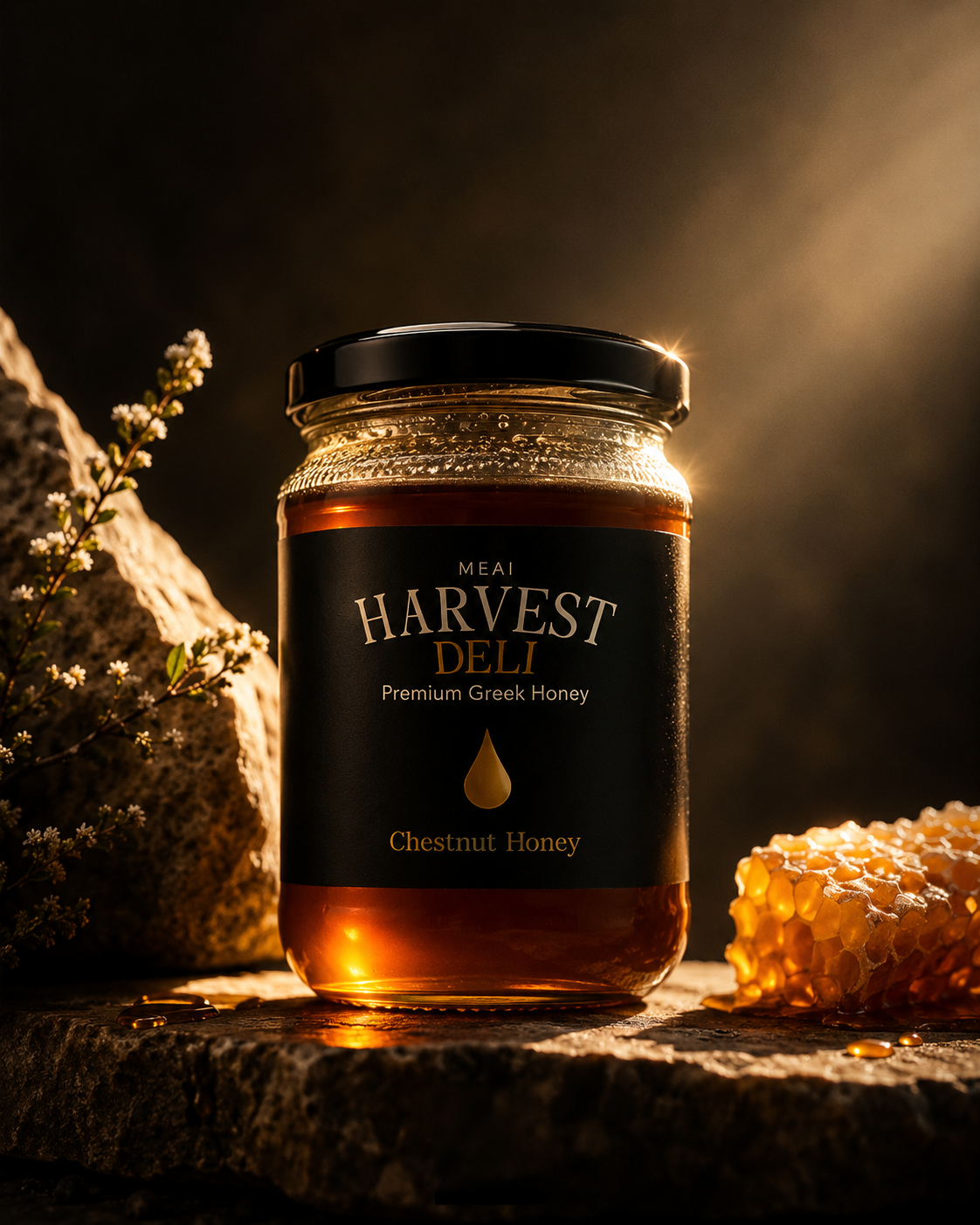
The Greek sun is not a metaphor. It has a temperature, a colour, a pressure on the skin at three in the afternoon. And it has a taste, gathered slowly by ten thousand bees on the southern face of a single mountain, then carried down in shallow trays, spun cold, and rested for fourteen days in oak.
This is a field guide to that taste. It is not a tour of every Greek honey, of which there are many. It is a way of reading one jar, a single edition, a single season, a single estate, and learning what the mountain was saying that year.
If you have never tasted raw Greek honey from altitude, the first surprise is that it does not taste sweet. Or rather: sweetness is the smallest thing it does. What it does instead is hold a season in suspension. The thyme that bloomed for nine days in June. The way the air dried out by Tuesday afternoon. The cold night of the seventeenth, which slowed the bees and thickened what they brought back.
I.What the Greek sun actually tastes like
The honey of a southern Mediterranean mountain has a flavour that other honeys cannot easily reach. It is denser. It is more mineral. It runs longer on the tongue.
There are reasons for this, and most of them are not romantic. The first is light. Pelion gets more than 2,800 hours of direct sun a year. The wild herbs that grow on its limestone ridges, thyme, oregano, sage, heather, are forced to concentrate their volatile oils against the heat. The bees forage on flowers that are already, in a sense, distilled.
The second reason is dryness. The southern face of Pelion holds a near-permanent gentle wind from the Aegean. The honey arrives at the comb with less water than a forest honey from a wetter climate. It comes out of the comb thicker, with more flavour per gram, and it crystallises differently: in small, fine, almost pearl-like grains.
The third reason is altitude. Above six hundred metres, the night cools quickly. The bees slow. The flow into the comb is gentler. There is more time for the honey to take on the character of the meadow it came from. A jar from a 950-metre chestnut grove will taste nothing like one drawn from a coastal orange grove fifty kilometres south. They share a language, but not a sentence.
Greek mountain honey is denser, more aromatic and more mineral than lowland honey because the herbs concentrate against the heat, the air is dry, and the altitude slows the harvest. Sweetness is the smallest part of what you taste.
II.Why Pelion, and why a single mountain
There are five great honey regions in Greece: Crete, the Peloponnese, Lakonia, Halkidiki and Pelion in Magnesia. Each one is shaped by a different geology, a different wind and a different flowering calendar. What sets Pelion apart, for the purpose of a single-estate jar, is the density of the bloom.
Within an hour's walk on the southern face you can pass through thyme, heather, arbutus, chestnut, oregano and wild marjoram. They flower in close succession through May, June and the long, slow weeks of July. A single colony of bees, placed at the right altitude, will work all of them in a season, and what arrives in the comb is a layered record of the bloom.
This is what people mean when they say "single-origin honey." It does not mean a single flower. It means a single landscape, working in one continuous season, recorded by one colony of bees.
The bees decide where to forage. The mountain decides what they bring back. We simply listen and write down the numbers.Stavros Andreou · Beekeeper, fifth generation
III.The slow art of cold extraction
Most commercial honey is heated. There is no scandal in this; it is how the industry runs. Heating thins the honey so it can be pumped through machinery, fine-filtered through cloth, blended across batches, and bottled at speed. The result is uniform, golden, and shelf-stable. It is also flat. Above 40°C, the volatile aromatic compounds begin to evaporate. Above 60°C, the enzymes that give raw honey its complexity break down.
At the Pelion estate, the combs are spun at 16°C in spring, 18°C in summer, the temperature of the cellar. They are not filtered, only settled. The honey rests for two weeks in oak vats. Air rises. Sediment falls. The honey separates itself, slowly, the way wine does.
What this preserves is the season. Every grain of pollen, every trace of propolis from the comb, every faint herb note that survived the journey down the mountain, all of it stays in the jar. This is what raw honey is. Everything else is a different product.
IV.How to taste a jar, in three movements
Greek honey is best read slowly. The following is the way we taste an edition in the cellar, before we sign off on a season. Try it once and you will read every honey, forever after, in three layers.
I. Smell, warm and slow.
Bring a small spoonful to room temperature. Hold it close to your face. Breathe in through your nose with your eyes closed. You are looking for the top note, usually resin, herb, smoke, or a single flower. Chestnut honey will give you warm tannin and pine. Thyme honey will give you something almost like crushed leaves and citrus skin.
II. Place a small amount on the centre of the tongue.
Let it dissolve. Do not chew or swallow. The texture and weight matter more than the sweetness. Note how slowly it moves. Note where on the tongue it settles. The body of a great honey is a quiet thing, it spreads, it pools, it warms.
III. Exhale through the nose, and listen.
Swallow, then breathe out slowly through your nose. This is where the finish lives, and where the mountain really speaks. The good honeys end with stone and salt, a long mineral echo. The flat ones end the moment they leave the mouth.
- Top note, the first impression in the nose, usually warm and aromatic.
- Body, the texture and weight on the tongue, the central sweetness, the way it moves.
- Finish, what remains after the spoon has been set down. The longer the better.
V.Pairing the harvest, quietly
Greek honey is not a sauce. It is a punctuation mark. The best pairings are restrained, one good honey, one good ingredient, nothing else competing.
- Chestnut honey with aged manouri, walnut bread, or a small glass of cold mountain tea. The tannins line up.
- Wild thyme honey with thick Greek yoghurt at breakfast, or fresh feta and warm bread. The acidity opens the honey.
- Pine & heather honey drizzled over dark chocolate, smoked almonds, or aged hard cheese. The dark resin meets the dark food.
- Orange blossom honey in a small spoon over goat's milk panna cotta, or stirred into hot tea with a slice of lemon.
- Spring wildflower honey on warm croissants, or melted into porridge with a few flakes of sea salt.
- Mountain Reserve alone, on a small wooden spoon, after a long meal. It does not need company.
VI.A note on numbered editions
Each year the estate produces a small number of jars per edition, fewer than four hundred, often closer to three hundred and eighty. Each one is numbered by hand and sealed in black wax. When an edition is gone, that season is closed. We do not keep stock between years, and we do not blend across harvests to extend a release.
This is not scarcity for the sake of marketing. It is the actual yield of a small estate, worked slowly, by one beekeeper and two nephews, on a single mountain. If you are reading this in early summer, the Chestnut edition is open. By autumn, it will be closed, and the journal will move on to the next harvest.
You can view the current editions in the collection, or read more about the family and the cellar in the origin.